
Project Management Frameworks for Building Technology: Waterfall, Agile, and Scrum Explained
A practical, end-to-end guide to the frameworks teams use to build software — what Waterfall, Agile, and Scrum actually are, how they differ, and how to choose the right one for the situation you are in.
- Project Management
- Agile
- Scrum
- Waterfall

Most failed technology projects do not fail because the engineers could not write the code. They fail because the way the work was organized never matched the reality the team was working in — requirements that kept changing were forced through a process that assumed they never would, or a project that needed a fixed scope and a fixed date was run as if it could discover its way to done.
Choosing a project management framework is choosing how your team will make decisions, absorb change, and measure progress. Get it right and the framework disappears into the background; get it wrong and you spend more energy fighting the process than building the product. This guide walks through the frameworks that dominate technology delivery — Waterfall, Agile, and Scrum, plus the most useful variations — and ends with a straight answer to the only question that matters: which one should you use?
What is a project management framework?
A project management framework is a reusable structure for how work moves from idea to delivery. It defines a handful of things: how work is broken down, who is responsible for what, how decisions get made, how progress is measured, and how the team responds when something changes.
A framework is lighter than a rigid methodology and heavier than “just wing it.” It gives you enough structure to coordinate a team without prescribing every detail. The two great families of frameworks differ on one fundamental belief: how much you can know up front. Waterfall assumes you can know most of it before you start. Agile assumes you cannot, and builds learning into the process.
Waterfall: plan everything, then build
Waterfall is the traditional, sequential approach. Work flows downward through distinct phases, and each phase must finish before the next begins.
How Waterfall works
A typical Waterfall project moves through five stages:
- Requirements — gather and document everything the system must do.
- Design — architect the full solution on paper before any code is written.
- Implementation — build the system to match the design.
- Verification — test the finished system against the requirements.
- Maintenance — fix issues and support the system in production.
The defining trait is that the plan is made once, in detail, at the start. The team commits to a fixed scope, and success means delivering that scope on time and on budget.
Where Waterfall fits — and where it hurts
Waterfall is genuinely good when the requirements are stable and well understood, when the cost of change is high, and when a fixed scope is contractually or legally required. Building firmware for hardware that ships on a fixed date, delivering a system to a strict regulatory specification, or executing a migration with an unambiguous definition of done are all reasonable Waterfall candidates.
It hurts when reality refuses to stay still. Because feedback only arrives at the verification stage — often months in — a wrong assumption made during requirements can survive untouched until it is expensive to fix. Waterfall has no built-in mechanism for “we learned something and need to change course.”
Waterfall’s strength is its discipline; its weakness is that the discipline assumes you were right at the beginning.
Agile: build, learn, adapt
Agile is not a single framework but a mindset, formalized in the 2001 Agile Manifesto. Instead of betting everything on an up-front plan, Agile delivers small, working increments, gathers feedback, and adapts. It treats change not as a failure of planning but as an expected, even welcome, source of information.
The Manifesto states four values:
- Individuals and interactions over processes and tools
- Working software over comprehensive documentation
- Customer collaboration over contract negotiation
- Responding to change over following a plan
That is, while there is value in the items on the right, we value the items on the left more.
The practical consequences are large. Work is delivered in short cycles. Priorities are revisited frequently. The customer or product owner stays involved throughout, not just at the start and the end. Progress is measured by working software in users’ hands, not by documents completed or phases signed off.
Agile is an umbrella. Underneath it sit concrete frameworks — Scrum, Kanban, Extreme Programming, and others — that turn the mindset into a working process. By far the most widely adopted is Scrum.
Scrum: Agile’s most popular framework
Scrum organizes work into fixed-length iterations called sprints, typically one to four weeks long. Each sprint aims to produce a usable increment of the product. Scrum is deliberately minimal: it defines a small set of roles, events, and artifacts, and leaves the rest to the team.
The three roles
- Product Owner — owns the what and the why. They manage the product backlog, set priorities, and represent the customer’s interests.
- Scrum Master — owns the how well the process runs. They coach the team, remove blockers, and protect the team from disruption. They are a facilitator, not a manager.
- Developers — the people who build the increment. In Scrum, the team is cross-functional and self-organizing: collectively they have every skill needed to turn backlog items into working product.
The five events
- The Sprint — the container for all other events; a fixed cadence in which work gets done.
- Sprint Planning — the team selects what to build this sprint and how.
- Daily Scrum — a short, daily sync to inspect progress and surface blockers.
- Sprint Review — the team demonstrates the increment and gathers feedback.
- Sprint Retrospective — the team inspects itself and commits to one or two concrete improvements for next sprint.
The three artifacts
- Product Backlog — the ordered list of everything that might be built.
- Sprint Backlog — the slice the team commits to this sprint, plus the plan.
- Increment — the working, potentially shippable product at sprint’s end.
Scrum’s power is its rhythm. Every sprint forces a small bet, a real deliverable, and an honest look at both the product (review) and the process (retrospective). Its weakness is overhead: for very small teams, or for a steady stream of unplanned work, the ceremony can cost more than it returns.
Beyond Scrum: the variations worth knowing
Scrum is not the only way to be Agile. Three variations come up constantly.
Kanban
Kanban drops fixed iterations entirely. Work is visualized on a board, flows continuously, and the central discipline is a work-in-progress (WIP) limit — a cap on how many items can be in any stage at once. Kanban optimizes for flow and is ideal for support, operations, and any team facing a continuous, unpredictable stream of work rather than a planned project.
Scrumban
Scrumban is the pragmatic hybrid: Scrum’s planning and review rhythm combined with Kanban’s continuous flow and WIP limits. Teams often land here when pure Scrum feels too rigid but they still want a regular cadence.
Extreme Programming (XP)
XP focuses on engineering excellence rather than project ceremony. Its practices — test-driven development, pair programming, continuous integration, and small frequent releases — pair naturally with Scrum or Kanban and raise the technical quality bar.
Scaling frameworks
When many teams must build one product together, frameworks such as SAFe (Scaled Agile Framework) and LeSS (Large-Scale Scrum) coordinate them. They add structure for alignment across teams — and that structure is only worth its cost at genuine scale. For a single team, they are overkill.
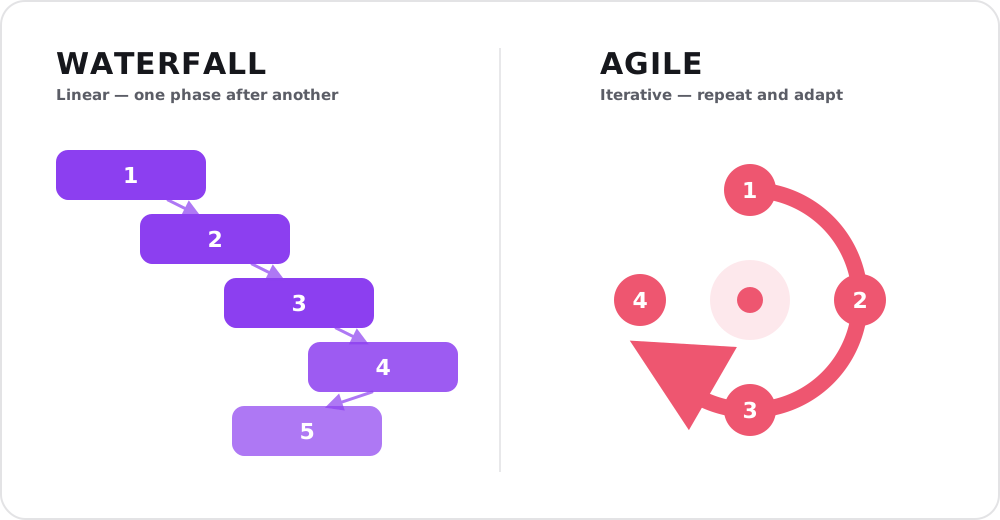
Waterfall runs once through its phases in order; Agile repeats a short cycle, learning and adjusting each time around.
Waterfall vs Agile vs Kanban at a glance
| Dimension | Waterfall | Scrum (Agile) | Kanban (Agile) |
|---|---|---|---|
| Planning | Detailed, up front | Per sprint, rolling | Continuous, on demand |
| Handles changing scope | Poorly | Well | Very well |
| Delivery | One release at the end | Increment each sprint | Continuous flow |
| Feedback loop | Late (after verification) | Every sprint | Continuous |
| Best for | Fixed, well-known scope | Evolving products, feature work | Ongoing, unplanned work |
| Main risk | Late discovery of wrong calls | Ceremony overhead on small work | Drift without clear goals |
How to choose the right framework
There is no universally best framework. There is only the best fit for your situation. Weigh these factors honestly:
- Requirement stability. Are the requirements truly fixed and understood, or will they be discovered as you go? Stable favors Waterfall; evolving favors Agile.
- Cost of change. If changing direction late is cheap (most software), Agile wins. If it is genuinely expensive or impossible (hardware, regulated systems), Waterfall’s discipline earns its keep.
- Need for early value. If the business needs working software in users’ hands quickly, iterative delivery is decisive.
- Type of work. A bounded project with a clear end suits Scrum. A continuous stream of incoming requests suits Kanban.
- Team size and maturity. Small teams thrive on lightweight Kanban or Scrumban; many coordinated teams may need a scaling framework; Scrum sits comfortably in the middle.
A few concrete recommendations:
- A new product with uncertain requirements → Scrum. The sprint rhythm turns uncertainty into a series of small, correctable bets.
- A support, maintenance, or operations team → Kanban. Continuous flow and WIP limits beat forcing unplanned work into fixed sprints.
- A fixed-scope, fixed-deadline, regulated build → Waterfall, or a “Water-Scrum-Fall” hybrid that plans up front but builds in iterations.
- A team that loves Scrum’s reviews but hates its rigidity → Scrumban.
- One product, many teams → Scrum first within each team, then a scaling framework only once the coordination pain is real.
Conclusion
The frameworks are tools, not religions. Waterfall is a sharp instrument for work you can fully specify before you start; its discipline is a feature precisely when change is rare and expensive. Agile, and Scrum as its most popular expression, is built for the far more common case in technology — where the smartest plan is the one that expects to be wrong and is designed to find out quickly and cheaply.
For most teams building software today, the honest default is an Agile framework: Scrum when the work is project-shaped with evolving features, Kanban when it is a continuous flow, and Scrumban when you want a bit of both. Reserve Waterfall for the genuinely fixed and the genuinely regulated. And remember the real goal: not to “do Scrum” or “do Waterfall” perfectly, but to ship technology that works, learn fast, and adapt the process to the team rather than the other way around.
If you would like a second opinion on how your next build should be run, that is exactly the kind of conversation we enjoy — reach out for a free consultation.